How Do Batteries Work? Battery Chemistry Explained
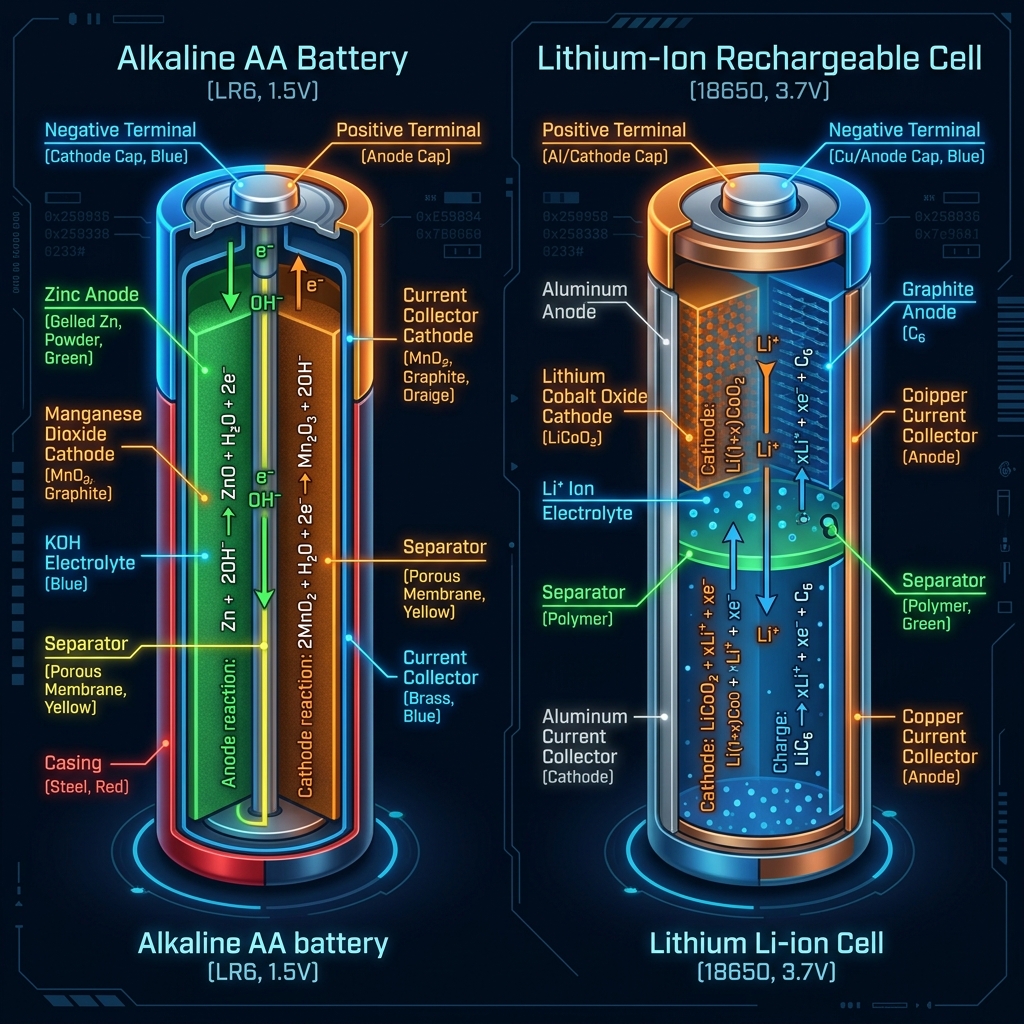
Understanding a battery means understanding how electrons are forced through a circuit to complete a chemical reaction.
A battery is, at its core, a small chemical reaction that's been carefully trapped so the electrons it releases have to flow through a wire — through your phone, your remote, your car — before they can complete the reaction. Understanding batteries means understanding one central idea: every battery is built around two different materials that "want" to trade electrons, kept apart until you connect a circuit and let that trade happen through your device.
The basic anatomy: anode, cathode, electrolyte
Every battery, from a AA cell to an electric car pack, has three essential parts:
- The anode (negative terminal) — the material that gives up electrons (oxidation happens here)
- The cathode (positive terminal) — the material that accepts electrons (reduction happens here)
- The electrolyte — a substance, usually a paste or liquid, that allows charged ions to move between the anode and cathode *inside* the battery, while forcing electrons to take the "long way round" through your external circuit
That last point is the whole trick of a battery. Ions can cross the electrolyte internally, but electrons can't — they're forced out through the terminal, through your device, and back in through the other terminal. That flow of electrons through your device is the electric current that actually powers things.
Alkaline batteries: the everyday AA/AAA cell
A standard alkaline battery uses zinc as the anode and manganese dioxide (MnO₂) as the cathode, with a potassium hydroxide paste as the electrolyte (that's where "alkaline" comes from — it's a base).
The two half-reactions look like this:
Zinc atoms lose electrons and get oxidized into zinc oxide, releasing electrons that travel out through the circuit. Those electrons come back in at the manganese dioxide side, where they drive a reduction reaction. Each electron that completes this loop through your flashlight or remote is one unit of the current you're using.
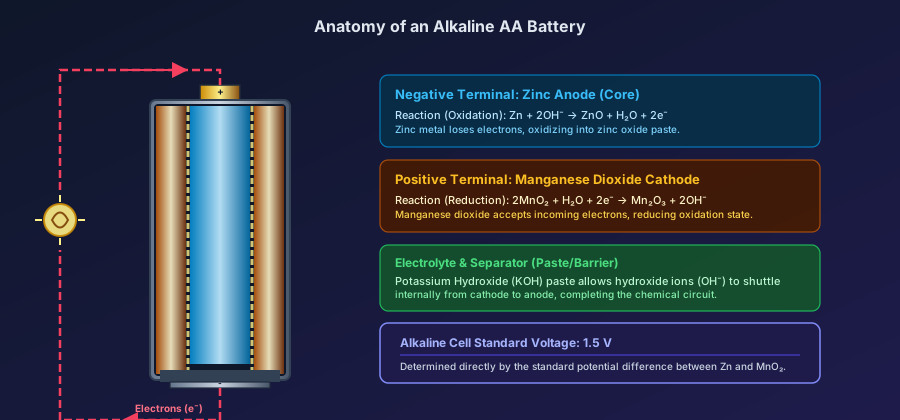
Figure 1: Cross-section anatomy of a standard alkaline AA cell, showing the inner zinc anode core and outer manganese dioxide cathode separated by electrolyte.
This is also exactly why a battery "dies": it's not that electricity runs out like water from a tank — it's that the usable zinc and manganese dioxide get consumed by the reaction. Once enough of the anode material has been converted, there's nothing left to oxidize, the reaction stops, and the battery can no longer push a useful current. This is a one-way chemical reaction, which is why standard alkaline batteries can't be recharged — you'd need to reverse a reaction that isn't built to run backward.
Rechargeable batteries: why some reactions *can* run backward
Rechargeable batteries (like nickel-metal hydride, NiMH, used in some AA-style rechargeables) are built around chemical reactions that are reversible. Applying an external voltage in the opposite direction — which is exactly what a charger does — pushes the electrons backward through the cell, driving the chemical reaction in reverse and restoring the original anode and cathode materials. That's the entire difference between a "regular" and a "rechargeable" battery: whether the underlying chemistry is a one-way street or a two-way one.
Lithium-ion: the chemistry that changed everything
Lithium-ion batteries — the kind in phones, laptops, and electric vehicles — work on a different principle called intercalation, where lithium ions physically slide in and out of layered material structures rather than the electrode materials themselves being permanently consumed and transformed.
A typical lithium-ion cell uses:
- **Cathode:** a lithium metal oxide, commonly lithium cobalt oxide (LiCoO₂) in phones, or lithium iron phosphate (LiFePO₄) in many EVs and power tools for better safety and longevity
- **Anode:** graphite, which has a layered structure that lithium ions can slot into and out of
- **Electrolyte:** a lithium salt dissolved in an organic solvent, which allows lithium ions (not electrons) to shuttle across
When you discharge the battery (use your phone), lithium ions move from the graphite anode, through the electrolyte, into the cathode material, while electrons take the external path through your device — the same anode/electrolyte/cathode principle as an alkaline cell, just with ions sliding into a structure instead of triggering a permanent chemical transformation.
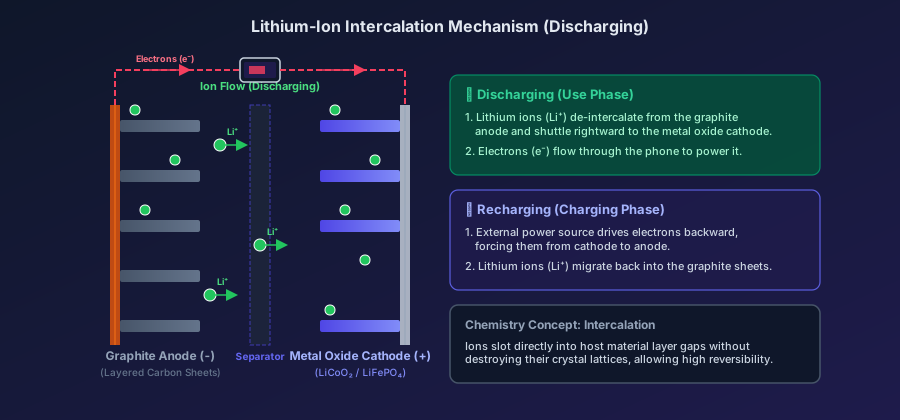
Figure 2: Shuttling mechanism of lithium ions between layered graphite (anode) and metal oxide (cathode) during charge and discharge.
This is exactly why lithium-ion batteries can be recharged hundreds of times with comparatively little degradation: charging simply pushes the lithium ions back the other way, sliding back into the graphite layers, ready to repeat the cycle. Contrast that with the alkaline reaction above, where zinc genuinely converts into a different compound that can't easily be pushed back to its original form.
Degradation still happens over time — repeated ion movement gradually causes physical wear in the electrode structures, and this is the real chemistry behind why an old phone battery holds less charge and why manufacturers rate batteries by charge cycles, not just age.
Voltage: where does the number on the battery come from?
The voltage printed on a battery (1.5V for alkaline, roughly 3.6–3.7V per lithium-ion cell) isn't arbitrary — it comes directly from the difference in each material's natural tendency to gain or lose electrons, a property chemists measure as standard electrode potential. Zinc and manganese dioxide happen to produce a voltage difference of about 1.5V; lithium's chemistry, being a much more reactive element, produces a substantially higher voltage per cell, which is a large part of why lithium-ion technology can pack more energy into a smaller, lighter battery than older chemistries — a key reason it enabled the modern smartphone and electric vehicle.
Why batteries lose capacity in the cold
Chemical reactions in general slow down at lower temperatures, and battery reactions are no exception — the ions inside the electrolyte move more sluggishly in the cold, which is exactly why phone batteries drain faster and car batteries can struggle to start an engine in winter. It's not that the battery has "less energy" in the cold — it's that the chemical reaction supplying that energy is running at a reduced rate, temporarily limiting how much current it can deliver.
The short version
- A battery works by physically separating a material that wants to give up electrons (anode) from one that wants to accept them (cathode), forcing those electrons through your device instead of letting them react directly.
- Alkaline batteries consume zinc and manganese dioxide in a one-way chemical reaction, which is why they can't recharge and why they eventually die for good.
- Rechargeable batteries use reversible reactions that can be driven backward by an external charger.
- Lithium-ion batteries use a different mechanism — ions sliding in and out of layered materials — which is what allows hundreds of recharge cycles with relatively low wear.
- Battery voltage is a direct result of the specific chemistry involved, which is why different battery types (alkaline, lithium, lead-acid) all have different standard voltages.
Frequently Asked Questions
- Why can't you recharge a regular alkaline battery? Its chemical reaction converts zinc into a different compound (zinc oxide) in a way that isn't easily reversible with normal charging — the material itself has permanently changed, unlike lithium-ion's ion-sliding mechanism.
- Why do lithium-ion batteries degrade over time even without heavy use? Even at rest, slow internal chemical side-reactions and gradual physical wear in the electrode structure occur, which is why manufacturers specify both a cycle-life rating and a calendar-life rating for lithium batteries.
- Is it true that batteries can explode, and why? Lithium-ion batteries can undergo "thermal runaway" if damaged, overcharged, or manufactured with a defect — internal short circuits can cause the reaction to accelerate rapidly, generating heat and gas faster than it can safely dissipate. This is a real chemical hazard, which is why lithium batteries include protective circuitry and why damaged batteries should never be punctured or exposed to high heat.
- Do all batteries use the same voltage? No — voltage is determined by the specific chemicals involved. Alkaline cells are 1.5V, standard lithium-ion cells are roughly 3.6–3.7V, and lead-acid car battery cells are about 2V each (six cells in series make the familiar 12V car battery).
*Related: explore more Chemistry guides, or see how energy and reactions connect across subjects in our Matter, States & Phase Transitions guide.*
Join 10,000+ Students
Get our weekly Band 7+ IELTS vocabulary cheat sheet and exam strategies delivered straight to your inbox.