Why Is the Sky Blue? The Physics of Light Scattering
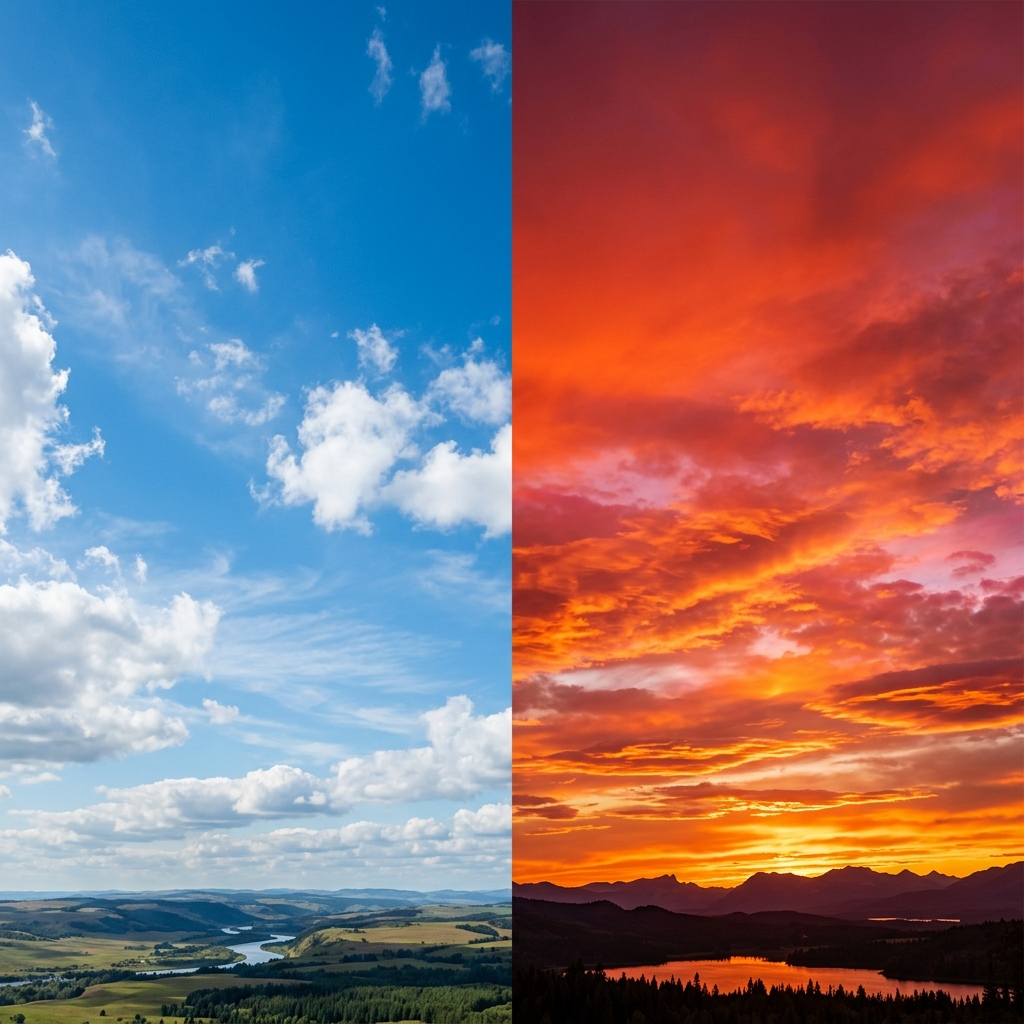
Same atmosphere, same sunlight — the path length through air is the only thing that changes between noon and sunset.
Look up on a clear afternoon and the sky is blue. Watch the sun go down over the same horizon a few hours later and it turns deep orange and red. Same sky, same sunlight, same atmosphere — so what changes? The answer is one of the cleaner, more satisfying stories in physics, and it comes down to a single idea: light doesn't travel through air unchanged. It bounces off the air itself, and it doesn't bounce off equally in every color.
Sunlight isn't white — it's every color at once
Start with what's actually coming from the sun. Sunlight looks white, but it's a mixture of every visible wavelength, from violet and blue (short wavelengths, roughly 400–450 nanometers) through green and yellow, out to orange and red (long wavelengths, up to about 700 nanometers). You can split it apart with a prism, or watch it happen naturally in a rainbow. Every color is present in roughly similar amounts before that light hits Earth's atmosphere.
The atmosphere is where the story gets interesting. Air is mostly nitrogen and oxygen molecules — particles far smaller than the wavelength of visible light. When light waves hit these tiny particles, the particles scatter the light in essentially every direction — and some colors get scattered far more efficiently than others.
Rayleigh scattering: the physics behind the color
This effect is called Rayleigh scattering, named after the 19th-century physicist Lord Rayleigh, who worked out the mathematics of how light scatters off particles much smaller than its own wavelength. The relationship he derived is deceptively simple:
Because the effect depends on wavelength raised to the *fourth power*, even a modest difference in wavelength produces a huge difference in how much a color gets scattered. Violet light (~400 nm) and red light (~700 nm) differ in wavelength by less than a factor of two — but plug those numbers into the formula and violet light scatters roughly (700/400)⁴ ≈ 9.4 times more strongly than red light.
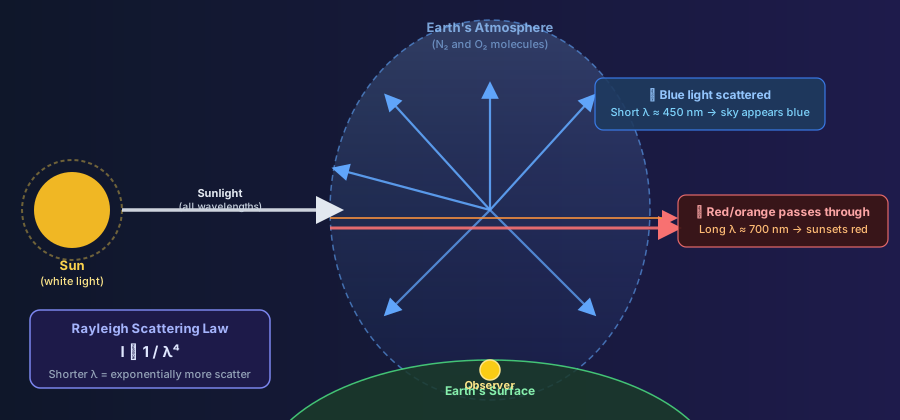
Figure 1: Blue short-wavelength light is scattered across the whole sky; red long-wavelength light travels straight through with minimal deflection.
Blue light sits close to violet on the spectrum (around 450–490 nm) and scatters nearly as strongly. So when sunlight hits the atmosphere, blue and violet wavelengths get knocked around and redirected across the whole sky far more than orange or red light does. Look in any direction *except* straight at the sun, and what you're seeing is scattered blue light arriving from that patch of sky.
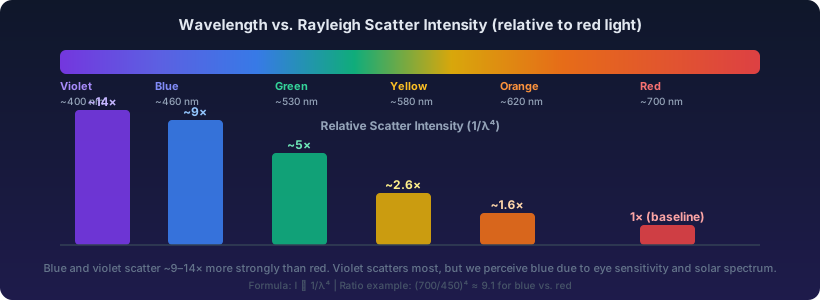
Figure 2: Relative scatter intensity by color wavelength (1/λ⁴). Violet scatters ~14× more than red; blue scatters ~9× more.
Why isn't the sky violet, if violet scatters even more?
Two reasons. First, sunlight simply contains less violet light to begin with than blue. Second, and just as important, the human eye's color receptors (cones) are far more sensitive to blue wavelengths than violet ones, and our brain's color processing blends the scattered light into what we perceive as blue rather than violet. So it's a mix of the physics of the light itself and the biology of human vision — the sky "is" blue partly because of how *we* see it, not purely because of the light alone.
So why do sunsets turn red and orange?
This is where the same equation explains the opposite-looking effect. At sunset, sunlight has to travel through a much *longer* path of atmosphere to reach your eyes — instead of coming from nearly overhead, it's grazing in at a low angle, passing through many times more air than it does at noon.
Over that much longer path, nearly all the blue and violet light gets scattered away long before it reaches you — scattered off in every direction, illuminating the rest of the sky, but not arriving directly along your line of sight to the setting sun. What's left, having survived that much longer trip largely undisturbed, is the light that scatters the least: orange and red. That's why the sun itself looks reddish-orange at the horizon, and why the sky around it can glow in deep reds, oranges, and pinks.
Dust, smoke, and pollution particles in the lower atmosphere often make sunsets even more vivid, since these larger particles scatter light differently (via a related effect called Mie scattering) and can add extra warm tones. This is part of why sunsets after wildfires or dust storms are sometimes strikingly intense.
Why Mars has a butterscotch sky (and other planets don't match Earth)
This isn't just an Earth story. Sky color is a direct readout of what's in a planet's atmosphere and how light interacts with it. Mars has a very thin atmosphere full of fine iron-oxide dust, which absorbs and scatters light very differently from Earth's nitrogen-oxygen mix. Instead of Rayleigh scattering dominating, dust scattering dominates — giving the Martian sky its familiar butterscotch/tan color during the day.
| Location | Dominant Atmosphere | Scattering Type | Sky Color |
|---|---|---|---|
| Earth (noon) | N₂ and O₂ molecules | Rayleigh (molecular) | Deep blue |
| Earth (sunset) | N₂ and O₂ + longer path | Rayleigh (long path) | Orange / red near sun |
| Mars (daytime) | CO₂ + iron-oxide dust | Mie (dust particles) | Butterscotch / tan |
| Mars (sunset) | CO₂ + dust (specific geometry) | Mie (forward scatter) | Blue-tinted near sun |
| Moon / Space | No atmosphere | No scattering | Black even in sunlight |
| Venus | Thick CO₂ + sulfuric acid clouds | Mie (cloud scatter) | Yellowish-orange |
Interestingly, Martian sunsets can look *bluish* near the sun — essentially the reverse pattern of Earth's — because the dust scatters blue light forward more efficiently in that specific geometry. It's a genuinely useful comparison: "sky color" isn't a fixed property of a planet; it's physics telling you what the atmosphere is made of.
The night sky and outer space
Astronauts in orbit or on the Moon see a black sky even in full sunlight, because there's no atmosphere (or a negligible one) to scatter light in the first place. No air molecules means no Rayleigh scattering means no blue sky — direct proof that the atmosphere itself, not sunlight alone, is what produces the color.
The short version
- Sunlight contains all visible colors, from violet to red.
- Air molecules scatter shorter wavelengths (blue/violet) far more efficiently than longer wavelengths (orange/red), following an inverse fourth-power relationship: I ∝ 1/λ⁴.
- Overhead, that scattered blue light reaches your eyes from every direction — hence a blue sky.
- At sunset, light travels through much more atmosphere, scattering away almost all the blue before it arrives, leaving the reds and oranges you see near the horizon.
- Different atmospheres (or no atmosphere at all) produce completely different sky colors — exactly what we see on Mars and in orbit.
- The sky is blue and not violet due to both the solar spectrum (less violet) and the biology of human color vision (eyes are more sensitive to blue).
Frequently Asked Questions
- Why is the sky blue and not violet, since violet scatters even more? Sunlight contains less violet light than blue to begin with, and the human eye is far more sensitive to blue wavelengths, so our brain perceives the combined scattered light as blue rather than violet.
- Why does the sky look darker blue at higher altitude or from an airplane? There's less atmosphere above you to scatter light as you go higher, so less blue light is being generated in your line of sight, and the sky appears darker — and eventually black in space.
- Does Rayleigh scattering affect anything other than sky color? Yes — it's also why the sky appears hazier and lighter blue near the horizon (you're looking through more atmosphere sideways than straight up) and it's why distant mountains often look blue-tinted, an effect sometimes called "aerial perspective."
- Is the same physics used anywhere in technology? Rayleigh scattering principles are used in atmospheric science and remote sensing to estimate particle sizes and air quality. Similar scattering physics also explains why optical fibers lose signal strength over very long distances — an effect engineers specifically design around.
*Related: explore the full Physics guides covering waves, optics, and mechanics — or dive into worked kinematics problems in our Kinematics guide.*
Join 10,000+ Students
Get our weekly Band 7+ IELTS vocabulary cheat sheet and exam strategies delivered straight to your inbox.